History & Timeline
“The pearl amongst fortresses in India” — Emperor Babur
2000+
years
3 km
length
100m
height
8+
dynasties
Overview
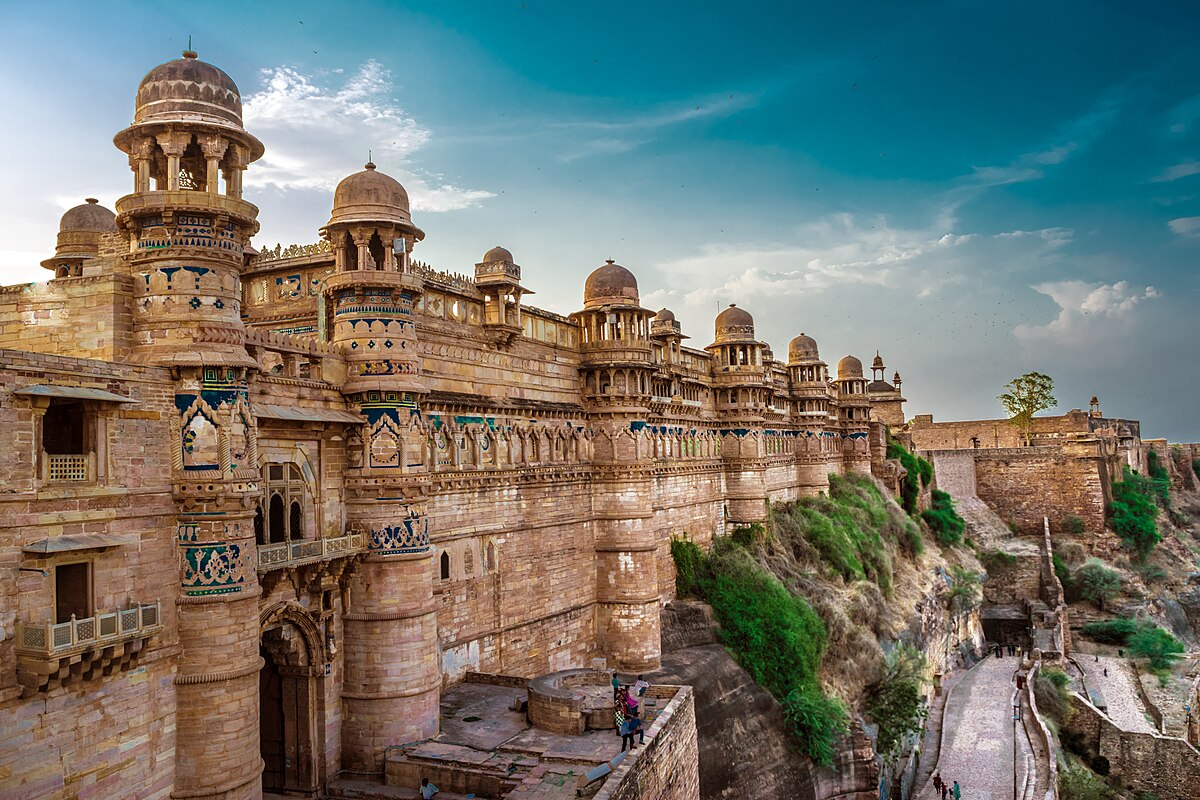
Gwalior Fort stands atop a flat-topped sandstone hill rising nearly 100 metres above the plains of central India. For over two millennia, it has witnessed the rise and fall of empires — from the Huns and Gurjara-Pratiharas to the Tomar Rajputs, Mughal emperors, Marathas, and the British. Emperor Babur called it "the pearl amongst fortresses in India." Its walls have endured more than a dozen major sieges, sheltered some of India's greatest treasures of art and architecture, and even housed the world's oldest recorded zero. Today it is one of India's most important historical monuments, protected by the Archaeological Survey of India and on the tentative list for UNESCO World Heritage status.
The Legend of Sage Gwalipa
In the 3rd century BCE, a local chieftain named Suraj Sen was afflicted with leprosy and wandered the hills in despair. He encountered a holy sage named Gwalipa meditating atop the rocky plateau. The sage offered him water from a sacred spring (now known as Suraj Kund). Upon drinking it, Suraj Sen was miraculously cured of his disease. In gratitude, he built a fort on the hilltop and named it after his saviour — Gwalipa became Gwalior. The sage bestowed a prophecy: the fort would remain in the king's family as long as they kept the name "Pal" (protector). Eighty-three descendants held the fort, but the 84th, who dropped the name Pal, lost it. This legend, though historically unverifiable, reveals the deep antiquity of the site and its sacred significance to the people of the region.
Dynasties That Ruled the Fort
Over 2,000 years, Gwalior Fort changed hands between some of India's most powerful dynasties
Early Rulers & Huns
3rd century BCE – 6th century CE
The earliest period of the fort is shrouded in legend. Historical evidence begins with inscriptions from the Huna (White Hun) rulers Toramana and Mihirakula (5th–6th century CE), found within the fort.
Key: Earliest known historical inscriptions within the fort
Gurjara-Pratihara Dynasty
8th–10th century
The powerful Pratihara dynasty controlled Gwalior Fort during a golden age of temple building. They constructed the magnificent Teli Ka Mandir — the tallest structure in the fort — representing a unique fusion of North and South Indian architecture.
Key: Built Teli Ka Mandir (tallest fort structure, ~100 ft)
Kachchhapaghata Dynasty
10th–11th century
Under the Kachchhapaghata rulers, Gwalior Fort saw continued architectural development. King Mahipala built the twin Saas-Bahu temples (1093 CE) with their remarkably intricate carvings. This period also saw the Chaturbhuj Temple inscription of 876 CE — containing the world's oldest zero.
Key: Built Saas-Bahu temples; zero inscription (876 CE)
Delhi Sultanate
1196–1398 (intermittent)
The fort was repeatedly attacked by Sultanate forces. Qutb-ud-din Aibak captured it in 1196 after a year-long siege. Iltutmish took it in 1232, and his forces damaged many of the Jain sculptures. The fort changed hands multiple times during this turbulent period.
Key: Multiple sieges; Jain sculptures first damaged
Tomar Rajputs
Golden Age1398–1518
The golden age of Gwalior Fort. The Tomar dynasty, particularly Raja Man Singh Tomar (r. 1486–1516), transformed the fort into a masterpiece of art and architecture. Man Singh built the iconic Man Mandir Palace with its spectacular blue tilework, the Gujari Mahal for his queen Mrignayani, and patronised music and the arts. His court musician Baijnath Mishra (who later became the legendary Tansen) first learned music here.
Key: Man Mandir Palace, Gujari Mahal, birth of Tansen's musical legacy
Mughal Empire
1518–1754
Ibrahim Lodi of the Delhi Sultanate captured the fort in 1518, killing Man Singh. Babur took it in 1527 and famously declared it "the pearl amongst fortresses in India" — but also ordered the destruction of Jain sculptures. Under Akbar and his successors, the fort served as a prestigious state prison. Aurangzeb imprisoned his brother Murad in Man Mandir's underground chambers, where Murad was eventually executed in 1661.
Key: Babur's "pearl" quote; Mughal state prison; Murad's execution
Maratha / Scindia
1754–1844
The Marathas, specifically the Scindia clan, gained control of Gwalior in 1754. Mahadji Scindia made Gwalior the capital of his powerful state. The Scindias held the fort through the turbulent late 18th century, though it changed hands briefly during conflicts with the British and other powers. The Scindia dynasty's influence on Gwalior continues to this day.
Key: Scindia dynasty establishes Gwalior as capital
British Period & Independence
1844–1947
After the Treaty of Gwalior (1844), the British gained significant influence. During the 1857 revolt, Rani Lakshmibai of Jhansi died fighting near the fort — she is one of India's most celebrated freedom fighters. The British established Scindia School (1897) within the fort complex. After independence in 1947, the fort became a protected monument under the Archaeological Survey of India.
Key: Rani Lakshmibai's last battle (1857); Scindia School founded
Complete Chronological Timeline
Legendary founding: Sage Gwalipa cures King Suraj Sen at Suraj Kund. Fort named Gwalior after the sage.
Buddhist monks create rock-cut meditation caves and sculptures along the fort hillside — evidence of an active Buddhist monastic community linked to Sanchi and Udayagiri.
Inscription of Huna ruler Toramana found in fort — earliest firm historical evidence of the site.
Mihirakula, son of Toramana and ruler of the White Huns, controls the fort and much of northern India.
Gurjara-Pratihara dynasty builds Teli Ka Mandir — the tallest structure in the fort at ~100 feet, uniquely blending Dravidian and Nagara styles.
Chaturbhuj Temple inscription records the world's oldest known use of zero as a numeral. Numbers 270, 187, and 50 appear with zeros written as small circles.
Mahmud of Ghazni attacks Gwalior Fort but is repelled. The fort's defences prove their worth.
King Mahipala of the Kachchhapaghata dynasty builds the twin Saas-Bahu temples within the fort, dedicated to Vishnu.
Qutb-ud-din Aibak captures Gwalior Fort after a year-long siege — the first Muslim conquest of the fort.
Sultan Iltutmish captures the fort. His forces damage Jain rock-cut sculptures along the fort approaches.
Colossal Jain tirthankara figures (up to 57 feet tall) carved into cliff faces along fort approaches, making it a major Jain pilgrimage centre.
Tomar Rajputs wrest control of the fort, beginning the golden age of Gwalior Fort.
Raja Man Singh Tomar builds Man Mandir Palace with its iconic blue-tiled facade, and Gujari Mahal for queen Mrignayani. He also patronises music — his court produces Tansen's early training.
Ibrahim Lodi captures the fort after a year-long siege. Raja Man Singh Tomar is killed in battle. End of the Tomar golden age.
Babur captures the fort and declares it "the pearl amongst fortresses in India." He also orders destruction of the Jain rock-cut sculptures — faces and limbs are hacked off.
Sher Shah Suri takes control of the fort from the Mughals, briefly interrupting Mughal rule.
Emperor Akbar recaptures the fort. He uses the Man Mandir Palace as a state prison for high-ranking political prisoners.
Aurangzeb imprisons his brother Murad in Man Mandir's underground chambers. Murad is executed here — one of the fort's darkest chapters.
Marathas under the Scindia clan capture the fort. Mahadji Scindia makes Gwalior the capital of his state.
The fort changes hands multiple times during the Anglo-Maratha Wars. The British and Scindias negotiate and fight over control.
Treaty of Gwalior — British gain significant influence over the Scindia state while allowing the dynasty to retain ceremonial control.
Rani Lakshmibai of Jhansi, one of India's greatest freedom fighters, dies in battle near Gwalior Fort during the 1857 revolt. She is 22 years old.
Scindia School, one of India's most prestigious boarding schools, is founded within the fort complex by Maharaja Madhav Rao Scindia.
Archaeological Survey of India begins restoration of the Jain rock-cut sculptures damaged by Babur in 1527.
Indian independence. Gwalior State merges with the Indian Union. The fort becomes an ASI-protected monument of national importance.
Gwalior Fort is on India's tentative list for UNESCO World Heritage status. It receives ~500,000 visitors annually. Nightly Sound & Light Shows narrate its history.
The Birthplace of Zero
876 CE — Chaturbhuj Temple, Gwalior Fort
The oldest known zero in a place-value system
In 876 CE, a scribe at the Chaturbhuj Temple within Gwalior Fort inscribed a land donation that would change the world. The inscription contains the numbers 270, 187, and 50 — with the zeros written as small circles in a place-value notation indistinguishable from modern usage. While the concept of zero (shunya) had been developing in Indian mathematics for centuries — appearing in the works of Brahmagupta (628 CE) and earlier — the Gwalior inscription is the oldest surviving stone inscription where zero appears as a numeral in the way we use it today. This seemingly modest temple inscription represents one of India's greatest gifts to world civilization: without zero, modern mathematics, computing, binary code, and essentially all of modern science and technology would be impossible.
The Mughal State Prison
Under Mughal rule (1558–1754), the underground chambers of Man Mandir Palace — originally designed as cool royal apartments — were converted into a high-security prison for political prisoners of the highest rank. Emperor Akbar used it to confine potential threats to his throne. The most infamous episode occurred in 1661 when Emperor Aurangzeb, having seized the Mughal throne in a war of succession, imprisoned his brother Prince Murad in these underground cells. Murad was later executed here on charges of murder — though historians widely regard the trial as a pretext for Aurangzeb to eliminate a rival claimant. The dark, windowless chambers where Murad spent his final days can still be visited, their thick walls a stark contrast to the vibrant tiles of the palace above.
Rani Lakshmibai & the 1857 Revolt
On June 17, 1858, the forces of Rani Lakshmibai of Jhansi captured Gwalior Fort from the Scindia ruler (who had sided with the British) during India's First War of Independence. The very next day, June 18, the British forces counterattacked. In the fierce battle that followed near Phool Bagh, the 22-year-old Rani, dressed in cavalry uniform and fighting sword in hand, was struck by a carbine bullet and slashed by a sabre. According to tradition, she ordered a trusted follower to burn her body so it would not fall into British hands. She died that day, becoming one of India's most iconic symbols of resistance against colonial rule. A memorial near the fort marks the site where she fell, and her legacy is commemorated annually.
Gwalior Fort Today
Gwalior Fort is maintained by the Archaeological Survey of India (ASI) and holds the status of a Monument of National Importance. It is on India's tentative list for UNESCO World Heritage Site nomination. The fort complex is open to visitors daily from 6:00 AM to 5:30 PM, with a Sound & Light Show every evening. Major restoration work has been carried out on the Jain sculptures, Teli Ka Mandir, and Man Mandir Palace. The fort receives approximately 500,000 visitors annually — both domestic tourists and international travellers. Scindia School, one of India's top boarding schools, continues to operate within the fort grounds. The fort remains the most prominent landmark of Gwalior city and a source of immense pride for its residents.